Subscribe to the LONGi Newsletter

In PV projects, component selection is most often based on declared manufacturer specifications and projected energy yields, derived from theoretical simulations. In practice, however, what matters most is something else entirely: how the system performs after several years of operation. It is only then that the manufacturer’s promise is truly verified from the end user’s perspective.
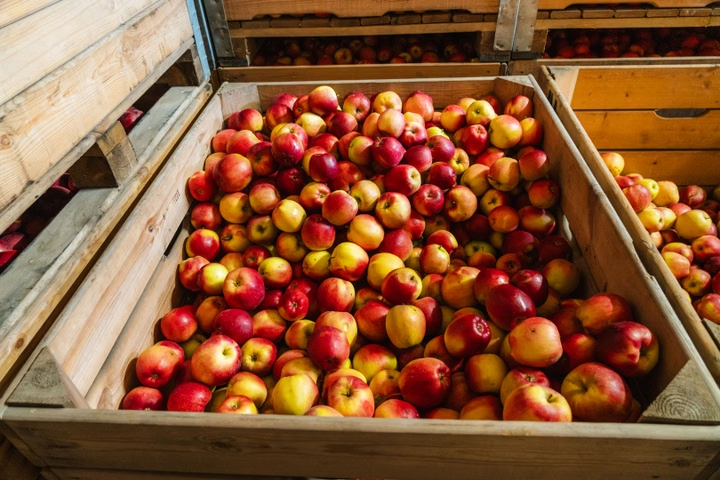
In 2019, Mirosław Łukiewicz, who owns an apple orchard farm near Warka, made the decision to invest in photovoltaics. In this type of business, electricity is not just a cost, but a critical operational resource. After six years of system use, the investor expanded the installation for the third time, and for the third time chose LONGi Solar modules.
Three stages of PV investment and over 180 MWh of energy produced on a working farm
The first photovoltaic installation was designed, delivered, and commissioned in 2019 by Bison Energy. The system, with a capacity of approximately 14 kWp and based on LONGi modules, was intended to support the day-to-day operations of the orchard.
After two years of operation, the investor decided to expand the system to approximately 30 kWp, working with the same installer and using the same components. In 2025, he once again contacted the contractor, initiating the third phase of the investment.
"I’ve been using photovoltaics for seven years. When the decision was made to build a new house, there was no doubt it would include solar modules. It was only when selecting solutions for the home that I realized how much the technology had advanced,” says Mirosław.
Today, after nearly seven years of operation, the installation has generated approximately 180 MWh of energy. This is not a one-time result, but the cumulative outcome of multiple seasons and varying weather conditions, providing tangible proof of the quality of the components used.
Investment decisions based on real performance
Each additional installation at the same site fundamentally changes the decision-making process. The investor no longer relies on offers or design assumptions, but on actual operational data and firsthand experience with the system.
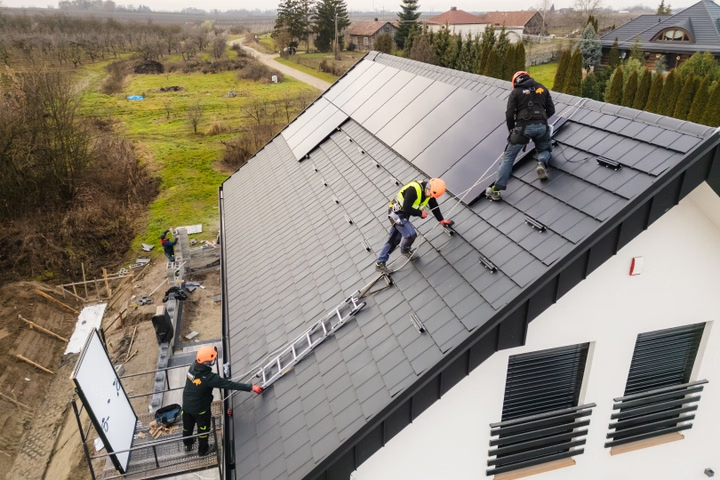
In the third phase, the project was extended to include a residential building. Alongside technical performance, factors such as aesthetics, architectural integration, and execution quality became equally important.
The selected solution was LONGi EcoLife modules based on back contact technology.
Seven years of PV development in practice mean higher power, better efficiency, measurable impact
Since the first installation in 2019, PV technology has advanced significantly. Module power has increased, efficiency has improved, and new design approaches have helped reduce energy losses under real operating conditions. Modules of similar size that previously delivered around 300 Wp now exceed 470–500 Wp. This translates directly into higher energy output from the same available installation area.
A key technological shift is the adoption of back contact architecture, where all conductive paths are moved to the rear of the cell. This increases the active surface area and reduces losses caused by partial shading. LONGi EcoLife modules, with built-in shading optimization, reduce energy losses by over 70% compared to standard solutions available on the market.
From the investor’s perspective, this translates directly into more efficient use of available space and greater system stability. "For the latest installation, we selected LONGi EcoLife modules. This decision was driven primarily by a comparison of their specifications with real-world performance. For us, the details matter, because we know they ultimately translate into the best results. In the EcoLife series, every detail plays a role and contributes to the overall efficiency of the module” says Tomasz Pijarczyk from Bison Energy.
Why choose LONGi again? Because time remains the ultimate benchmark for performance.
In photovoltaics, the most meaningful conclusions emerge over time. While datasheet parameters are important at the design stage, the true value of a system is revealed through long-term operation. Stability, lack of operational issues, and predictable energy output are the factors that ultimately shape investment decisions. That is why the decision to build another system using the same components and partners carries particular weight.
It is a conclusion based on experience. And in the long term, experience remains the most reliable indicator of quality.

Lorem ipsum dolor sit amet, consectetur adipiscing elit. Suspendisse varius enim in eros elementum tristique. Duis cursus, mi quis viverra ornare, eros dolor interdum nulla, ut commodo diam libero vitae erat. Aenean faucibus nibh et justo cursus id rutrum lorem imperdiet. Nunc ut sem vitae risus tristique posuere.