Subscribe to the LONGi Newsletter

Godella does not try to impress you. It simply exists with a subtle confidence. It is a town in Spain where music drifts out of rehearsal rooms and paintings are part of everyday life. Here, culture is not something you visit. You grow up with it.
At the same time, something new is gradually finding its place in these homes. Between the huerta, narrow streets, and terraces overlooking the landscape, there is a sense of continuity. Things evolve here, but rarely in a disruptive way. As in many parts of Spain, electrification is progressing, and solar energy is increasingly becoming a practical alternative. In a place like Godella, this transition feels less like a shift and more like a natural next step.
How a photovoltaic expert plans his own home in Godella
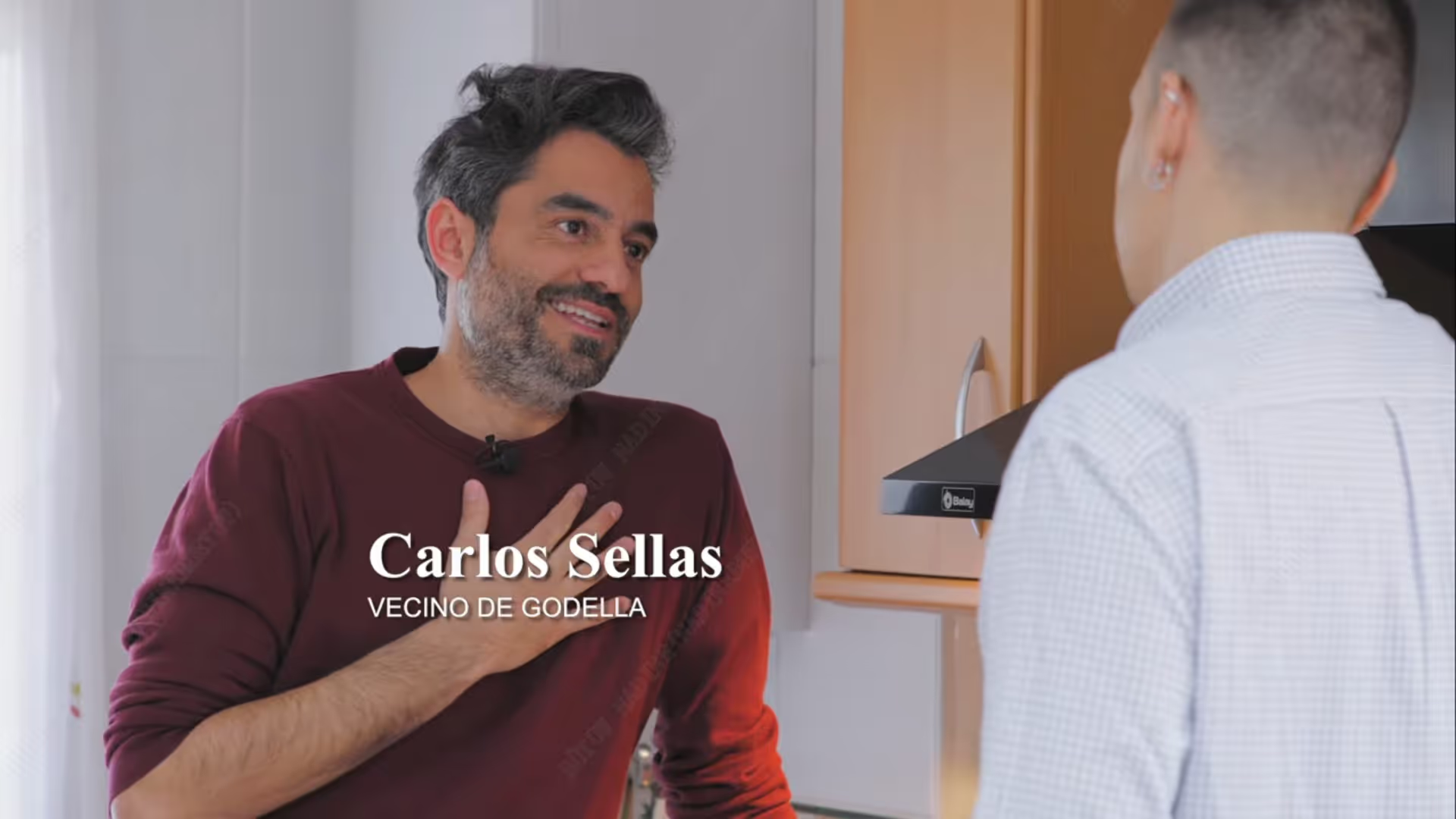
Carlos Sellas has spent more than 15 years in the photovoltaic sector, working across technical and commercial roles. Today, he is part of Enphase Energy, a company focused on residential solar systems based on microinverter technology.
His work has taken him through a wide range of projects, from individual homes to larger installations, always close to installers and end customers. This perspective has given him a clear understanding of how the market has developed and where expectations have shifted, especially when it comes to quality and system reliability. Planning his own installation added a new dimension.
“You understand the concerns of a homeowner much better,” he says. What had once been part of professional discussions becomes more immediate. Reliability, long-term performance, and how everything fits into the house are no longer abstract criteria. They become daily considerations.
The technical requirements were clear from the beginning. But applying those standards to his own home required a different level of precision. Every decision had to work not only on paper, but in real life.
The roof defines what is possible
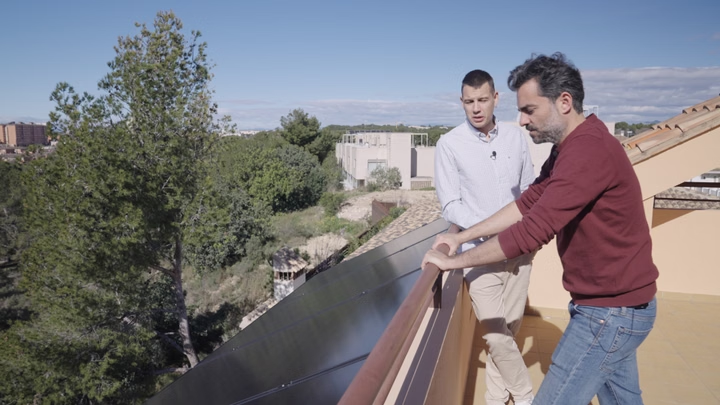
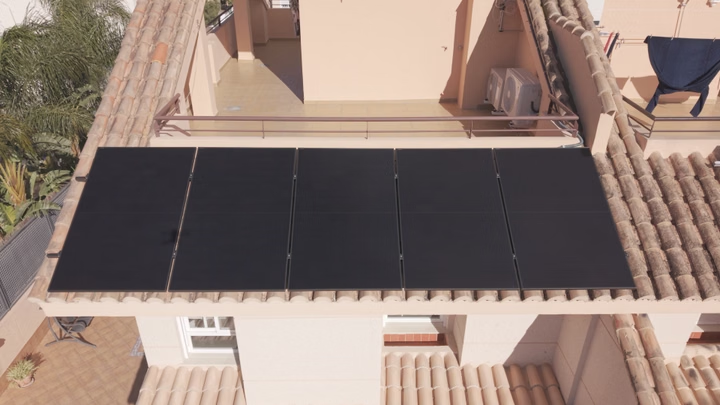
The project started with a constraint that is familiar in residential settings: the roof. Space was limited, and that shaped every decision that followed. Efficiency per square meter became critical, along with the physical dimensions of the modules and how they would fit into the existing structure. Carlos defined his requirements early: a compact module below 1.80 meters, high efficiency, and a full black design that would integrate cleanly into the building.
The final system combines LONGi EcoLife modules based on the high-performance Hi-MO S10 back contact series. The Hi-MO S10 represents the flagship of LONGi’s premium back contact homeowner portfolio. It owns features that directly address the needs of homeowners. One of these is the integrated shading optimizer. It ensures that if part of the roof is affected by shade, for example from a chimney or nearby tree, the rest of the system continues to generate power reliably instead of being pulled down by a single underperforming module.
In a climate like Spain, homeowners are also keen to understand: how does the system behave under heat? With a low temperature coefficient of around −0.24% per °C, the EcoLife module loses only a small fraction of its output as temperatures rise. In practical terms, this means that on very hot summer days, when rooftop temperatures can be far above standard test conditions, the system continues to generate a higher share of its rated power compared to conventional modules. Combined with a design that helps reduce the risk of hot spots, this results in more stable performance exactly when solar irradiance is at its highest.
Carlo’s system itself is deliberately compact. Nine modules, just over 4.4 kWp in total. On a roof like this, it is not about installing more, but about making every module count.
Over the course of a year, the system is expected to generate around 6,800 kWh, covering a significant share of the household’s demand while feeding excess energy into the grid.
Reducing costs and increasing independence at home
Inside the home, the focus quickly shifts away from technical specifications to how the system behaves over time. How it supports daily consumption. How it reduces dependence on external energy. For Carlos, solar has always been a practical investment. One that not only lowers electricity costs, but also supports the gradual electrification of the home, from appliances to mobility.
Looking ahead, he expects steady growth in the residential segment which would largely be driven by long-term economic considerations and changing energy patterns.
The installation reflects how residential solar is becoming a standard element of modern homes. Projects are shaped by real constraints and long-term thinking. For someone like Carlos Sellas, designing his own installation reinforces what matters most. The system has to fit the roof, perform reliably over time, and integrate into the home both technically and visually. When these conditions are met, the decision does not feel complex. It feels obvious, natural and almost inevitable.
Music and art define the character of Godella. Solar is becoming part of how that character evolves into the future.
See our team and Pau Borreda in action in Godella:

Lorem ipsum dolor sit amet, consectetur adipiscing elit. Suspendisse varius enim in eros elementum tristique. Duis cursus, mi quis viverra ornare, eros dolor interdum nulla, ut commodo diam libero vitae erat. Aenean faucibus nibh et justo cursus id rutrum lorem imperdiet. Nunc ut sem vitae risus tristique posuere.