Contact info
Nadine Bütow
Head of Corporate Communications, LONGi Distributed Generation Europe
nadinebuetow@longi.comSubscribe to the LONGi Newsletter

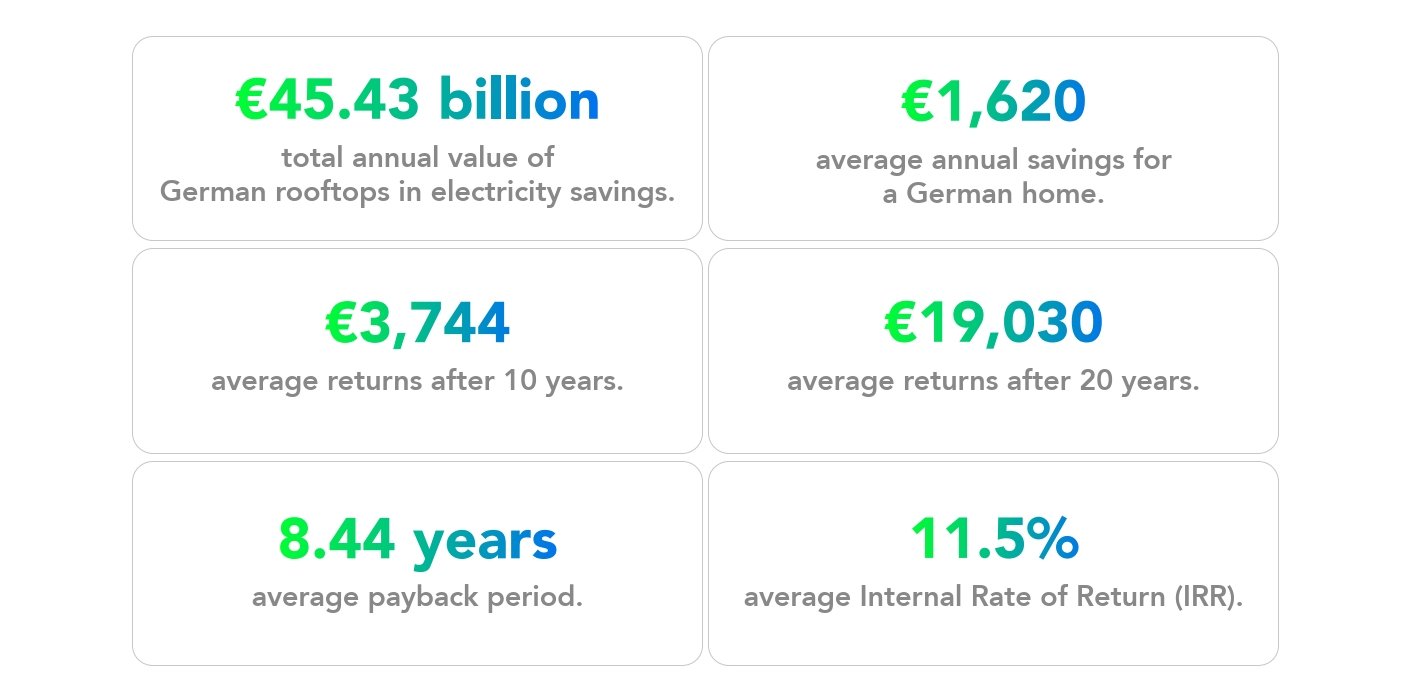
German homeowners are leaving an estimated €45.43 billion in annual electricity cost savings unused on their rooftops. This is the key finding of the German Rooftop Valuation Report 2026, a new nationwide study published by GreenSketch in collaboration with LONGi Solar. For the first time, the analysis evaluates more than 28 million residential buildings across all 401 German districts and independent cities to quantify the economic potential of rooftop solar and battery storage.
The report finds that residential solar remains economically attractive across Germany, even without government subsidies. Based on an optimized system configuration consisting of a 10.34 kWp photovoltaic system and a 9.6 kWh battery storage system, the average German household could save approximately €1,620 per year in electricity costs. With an average investment of €12,167, the modeled system achieves a nationwide payback period of 8.44 years and generates an average return of €19,030 over 20 years. The average internal rate of return reaches 11.5 percent.
The study was conducted by GreenSketch, an AI-powered platform for the solar industry developed by the Australian OSW Group. Launching in Germany this week, the platform combines rooftop assessment, lead generation, system design and proposal creation in a single digital workflow designed to support solar installers and energy consultants.
Solar remains attractive despite changing market conditions
The report is published at a time when Germany's residential solar market faces increasing uncertainty. At the end of 2025, around 4.1 million German homes had installed rooftop solar systems, indicating significant untapped potential across the country's residential building stock. Proposed changes under the draft Renewable Energy Act (EEG) 2027 could reduce the role of traditional feed-in revenues and increase the importance of self-consumption. Against this backdrop, the analysis highlights the economic potential of rooftop solar paired with battery storage under evolving market conditions.
"Precisely because the framework conditions are changing, homeowners and installers need reliable data on what a roof is actually worth," said Christian Seidemann, Lead CSM DACH at GreenSketch. "For the first time, this report delivers an address-level valuation for all of Germany and shows that a solar roof can pay for itself even without subsidies."
Significant regional differences across Germany
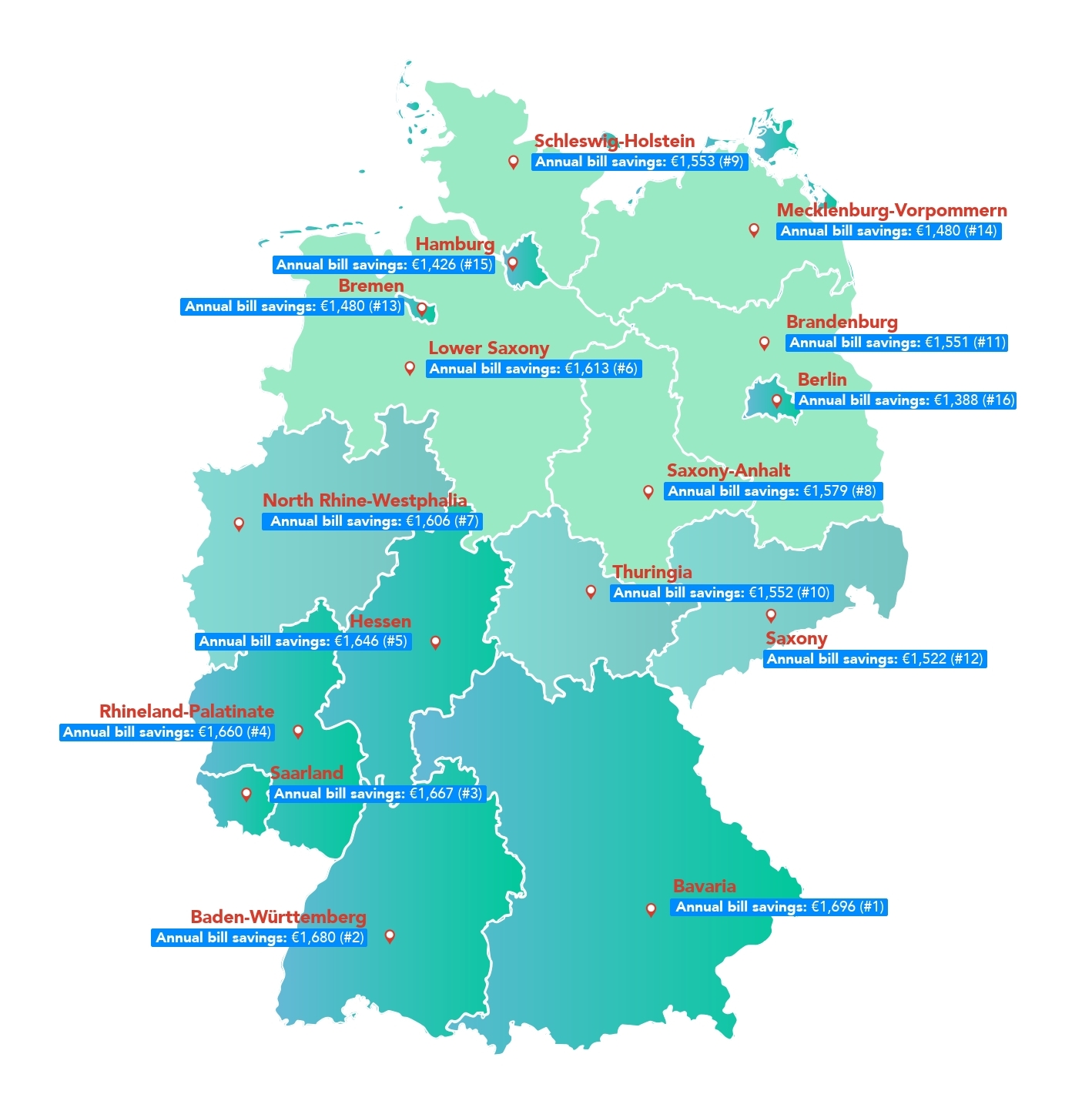
The analysis reveals substantial regional differences in the modeled economics of rooftop solar and battery storage. Bavaria ranks first across all major indicators, with the modeled system generating an average 20-year return of €20,504 and a payback period of 8.00 years. Baden-Württemberg follows closely behind, while Saarland and Rhineland-Palatinate also perform strongly.
Berlin records the lowest modeled returns, with annual savings of €1,388, a payback period of 10.10 years and a 20-year return of €14,555. However, the analysis indicates positive returns across every state, suggesting that rooftop solar can provide economic benefits throughout Germany.
The differences largely reflect variations in building structures and rooftop characteristics. States with a larger share of detached housing and lower building density generally achieve stronger returns, while densely populated urban areas show lower but still positive economics.
"For many people, a roof is still simply a part of their house, but this report demonstrates that it can also be a valuable economic asset," said Nadine Bütow, Head of Communication, LONGi Solar DG Europe Business Group. "The findings make it clear that photovoltaics remain economically attractive across Germany and underline the importance of self-consumption. Battery storage and intelligent energy management systems can help homeowners utilize a larger share of the electricity they produce themselves and further increase the long-term value of their investment."
AI enables Germany's first nationwide rooftop valuation
More than 28 million residential buildings were individually assessed using satellite imagery, geographic information systems (GIS) and artificial intelligence. GreenSketch's AI agent Emily reconstructs buildings as 3D models from 2D imagery and evaluates roof orientation, pitch and shading conditions on an address-specific basis. More than 87 percent of all buildings were reconstructed into detailed 3D models, enabling address-level rooftop assessments across Germany.
The report marks the official launch of GreenSketch in Germany. The platform combines rooftop analysis, lead generation, system design and proposal creation in a single workflow for solar installers and energy consultants. At the same time, homeowners can use the AI agent Emily free of charge to evaluate the solar and storage potential of their property and explore potential savings and returns.
Download the study: https://short.longi.digital/roof-report-en
Access AI-agent Emily: https://c.greensketch.ai/de/emily
About GreenSketch
GreenSketch is an AI-powered platform for the solar industry developed by the OSW Group, Australia's leading solar distributor. The platform combines rooftop analysis, system design, lead generation, and proposal creation in a free end-to-end solution for solar installers. More than 700 installers worldwide already use the platform.
greensketch.ai
About the OSW Group
The OSW Group (One Stop Warehouse) is Australia's leading solar distributor, generating more than AUD 1 billion in revenue during the first four months of 2026. The company provides an integrated ecosystem for distributed solar and energy solutions.
osw.energy

Lorem ipsum dolor sit amet, consectetur adipiscing elit. Suspendisse varius enim in eros elementum tristique. Duis cursus, mi quis viverra ornare, eros dolor interdum nulla, ut commodo diam libero vitae erat. Aenean faucibus nibh et justo cursus id rutrum lorem imperdiet. Nunc ut sem vitae risus tristique posuere.