Contact info
Nadine Bütow
Head of Corporate Communications, LONGi Distributed Generation Europe
nadinebuetow@longi.comSubscribe to the LONGi Newsletter

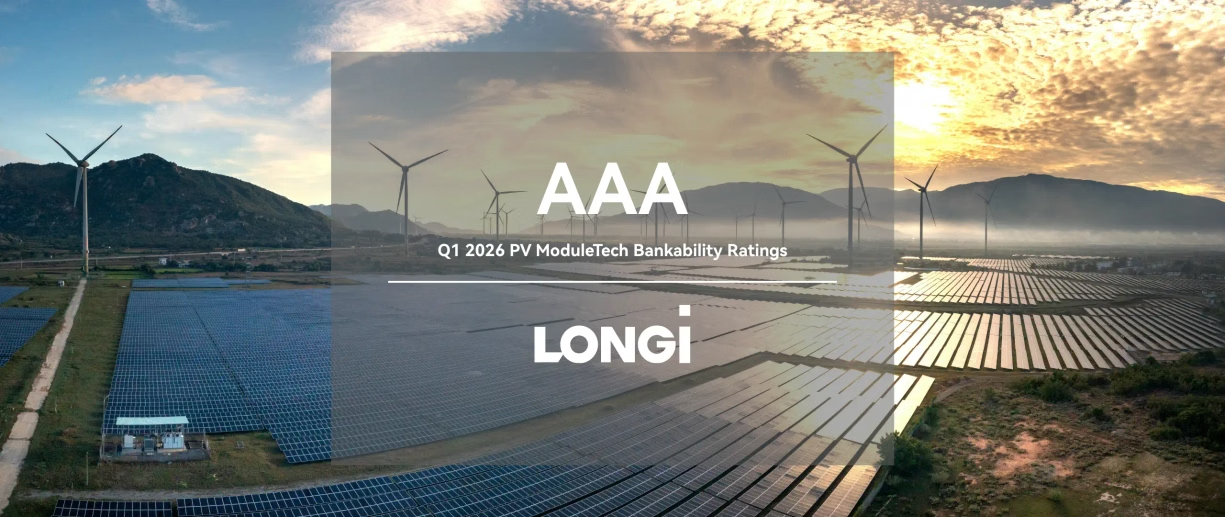
LONGi has retained its AAA bankability rating in the Q1 2026 release of the PV ModuleTech Bankability Ratings report. This achievement marks the 25th consecutive quarter that the company has occupied the highest possible tier in the rankings, a position it has held consistently since 2020. The ranking underscores the company's sustained manufacturing scale and its transition toward a differentiated technology portfolio.
Back contact technology supports performance predictability and asset value
Back contact technology plays a growing role in differentiating photovoltaic assets at the system level. LONGi’s focus on HPBC 2.0 cell architecture reflects a shift toward designs that reduce front-side shading losses and enable more stable energy generation under real operating conditions. For project developers and investors, this contributes to improved yield forecasts and greater confidence in long-term performance assumptions, which are central to bankability assessments.
European deployment and partnerships reinforce delivery track record
Europe remains a key market for advanced module deployment. Recent milestones include the supply of modules to a 450 MW project in Hungary, currently the largest back contact installation in Europe. In parallel, a three-year supply agreement with Energy 3000 covering 2 GW of HPBC 2.0 products strengthens visibility on mid-term delivery volumes.
Integrated storage supports revenue stability and grid compliance
The integration of storage solutions for C&I and large-scale applications within the LONGi ONE framework addresses increasing requirements for grid stability, peak load management, and market participation across European energy systems. By combining photovoltaic generation with storage at system level, projects can achieve more predictable output profiles and improved alignment with demand and pricing signals. This supports revenue optimization strategies and strengthens the overall financial case for both utility-scale and commercial installations.

Lorem ipsum dolor sit amet, consectetur adipiscing elit. Suspendisse varius enim in eros elementum tristique. Duis cursus, mi quis viverra ornare, eros dolor interdum nulla, ut commodo diam libero vitae erat. Aenean faucibus nibh et justo cursus id rutrum lorem imperdiet. Nunc ut sem vitae risus tristique posuere.