Subscribe to the LONGi Newsletter

Higher energy density reduces the physical footprint of utility-scale and rooftop solar installations
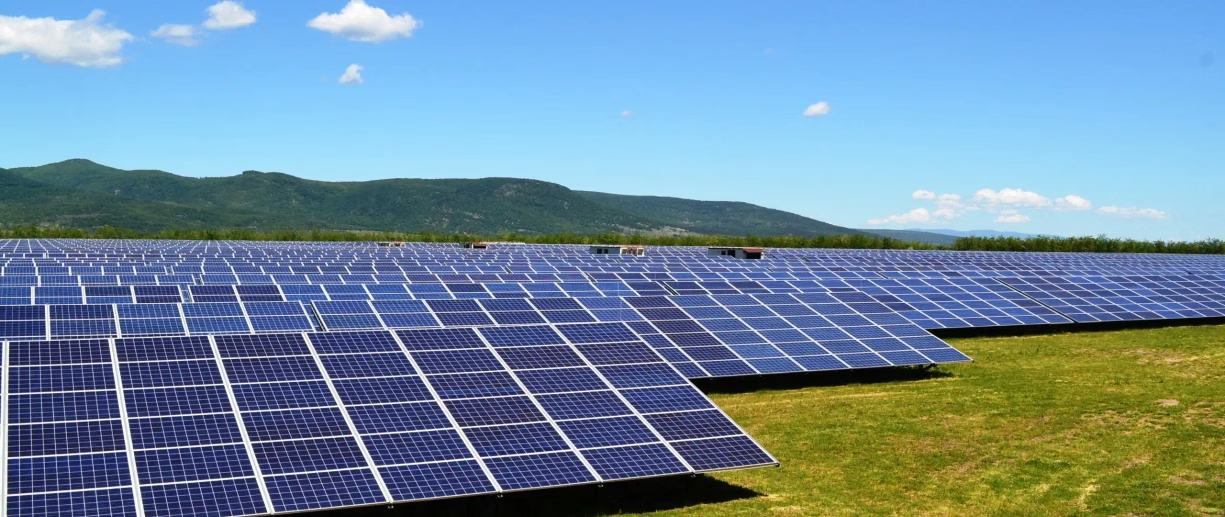
European energy markets face increasing physical and regulatory constraints as the competition for arable land and urban space intensifies. Governments are tightening restrictions on ground-mounted solar systems to protect food security, while rooftop developers face fixed installation areas despite rising electricity demand.
Improving energy density is therefore becoming a central requirement for utility-scale and rooftop solar projects in Europe. Higher-efficiency module technologies can help developers maximize output within increasingly constrained physical space.
LONGi addresses this challenge through the mass production of Hybrid Passivated Back Contact (HPBC) 2.0 modules designed to increase power generation per square meter.
Back contact architecture eliminates front-side shading to maximize energy density
LONGi’s HPBC 2.0 technology achieves commercial module efficiencies of up to 24.8 percent by relocating all electrical contacts to the rear of the cell. This design removes front-side shading and increases the active surface area available for light absorption compared with conventional module architectures.
Field results confirm that solar modules featuring the 2.0 cell generation generate 1.84 percent more power on a watt-for-watt basis compared to standard components. Higher power generation per unit area effectively lowers the land requirements for specific capacity targets.
HPBC 2.0 maintains energy yields in shading-prone environments
Space-constrained solar projects often require installations in environments affected by partial shading, including agrivoltaic systems and urban rooftops with multiple obstructions. LONGi’s Hybrid Passivated Back Contact architecture reduces power loss from partial shading by up to 70 percent compared with conventional cell designs.
Conventional modules can experience significant output losses when parts of the system are shaded. HPBC 2.0 maintains higher energy yields through a redesigned internal circuit architecture that reduces the impact of partial shading.
This allows developers to install modules with tighter spacing while maintaining reliable performance in environments where shadows cannot be fully avoided. Maintaining stable energy generation under these conditions is becoming increasingly important for projects with limited installation space.
Higher energy density reduces LCOE in space-constrained solar projects
The economic viability of solar projects in Europe increasingly depends on maximizing electricity generation within limited installation space. High land costs, rooftop constraints, and stricter permitting requirements place greater emphasis on energy yield per square meter.
Performance gains associated with back contact technology contribute to measurable Levelized Cost of Electricity (LCOE) reductions of between 3.32 percent and 4.47 percent across different project scales. Higher energy density allows developers to maintain strong generation performance while reducing the land area or structural adaptations required for installation.
Performance data from European projects indicates that these efficiency gains contribute directly to project bankability, particularly in markets where tender systems increasingly reward high energy yield and optimized land use.
As land availability and permitting constraints continue to tighten across Europe, higher energy density enabled by back contact technology is becoming a key factor in the long-term viability of solar projects.

Lorem ipsum dolor sit amet, consectetur adipiscing elit. Suspendisse varius enim in eros elementum tristique. Duis cursus, mi quis viverra ornare, eros dolor interdum nulla, ut commodo diam libero vitae erat. Aenean faucibus nibh et justo cursus id rutrum lorem imperdiet. Nunc ut sem vitae risus tristique posuere.