Contact info
Nadine Bütow
Head of Corporate Communications, LONGi Distributed Generation Europe
nadinebuetow@longi.comSubscribe to the LONGi Newsletter

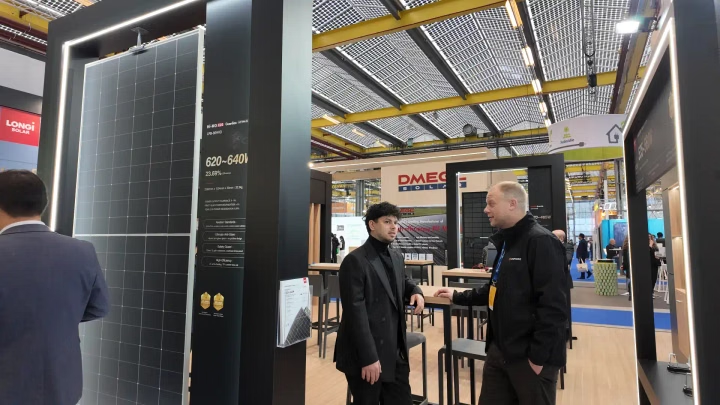
LONGi has introduced the Hi-MO X10 Guardian Anti-Glare Pro, a photovoltaic module designed for projects where reflected light is subject to regulatory review or stakeholder scrutiny. These include installations near airports, transport corridors, and urban environments, where reflections can affect visibility and are assessed within regulatory approval processes. The module integrates micro-structured glass with back contact cell architecture to diffuse reflected light and enhance light capture while maintaining high energy yield. Independent testing by TÜV Rheinland confirms a maximum Daylight Glare Probability (DGP) of 0.29 under EN 17037, corresponding to the highest imperceptible glare classification rated AAA. Maximum measured glare luminance is 2,480 cd/m². Under defined laboratory conditions, total reflectivity can be reduced to approximately 0.9 percent.
The Anti-Glare Pro is part of a broader Anti-Glare portfolio. The series offers power outputs of up to 670 W and module efficiencies of up to 24.8 percent, based on LONGi’s HPBC 2.0 cell technology. The Anti-Glare Pro variants extend this range with enhanced glare control for applications where reflection behavior must be controlled under regulatory and operational constraints.
Glare control as a permitting factor
In many infrastructure and commercial projects, glare assessments have become part of the approval process. Reflected light from photovoltaic installations can affect pilots, drivers, or surrounding buildings, which may lead to project delays or additional mitigation requirements. The Hi-MO X10 Guardian Anti-Glare Pro is designed for applications where glare or is subject to formal regulatory assessment and can influence project approval.
Jia Chao, President of LONGi DG Europe, said: “As solar becomes part of broader infrastructure, how a system interacts with its surroundings becomes as important as how much energy it produces. Glare is increasingly a determining factor in project approval, especially in infrastructure-related environments. For developers, this can define whether a project moves forward. If reflection behavior is not properly addressed, it can lead to delays, costly redesigns, and reputational consequences. The Hi-MO X10 Guardian Anti-Glare Pro is designed to address these requirements at module level, enabling projects in environments where these risks must be managed from the outset.”
Micro-structured glass drives glare control while back contact technology preserves efficiency
The optical performance results from the interaction between micro-structured glass and back contact cell architecture. The glass surface diffuses reflected light and reduces specular intensity, while the back contact design enhances light capture by eliminating front-side metallization. Together, this enables controlled reflection behavior while maintaining high transmittance above 93 percent.
Laboratory measurements from a Singapore SAC-certified OTM laboratory indicate that total reflectivity can be reduced to approximately 0.9 percent under defined test conditions, compared to around 2.9 percent in conventional module structures measured under the same conditions. Additional testing by the China Photovoltaic Testing Center (CPVT) shows that glare brightness can be reduced by up to 78 percent under defined test conditions compared to conventional module designs. These results align with independently validated glare performance under EN 17037 (AAA).
Validation in a large-scale airport-adjacent photovoltaic replacement project
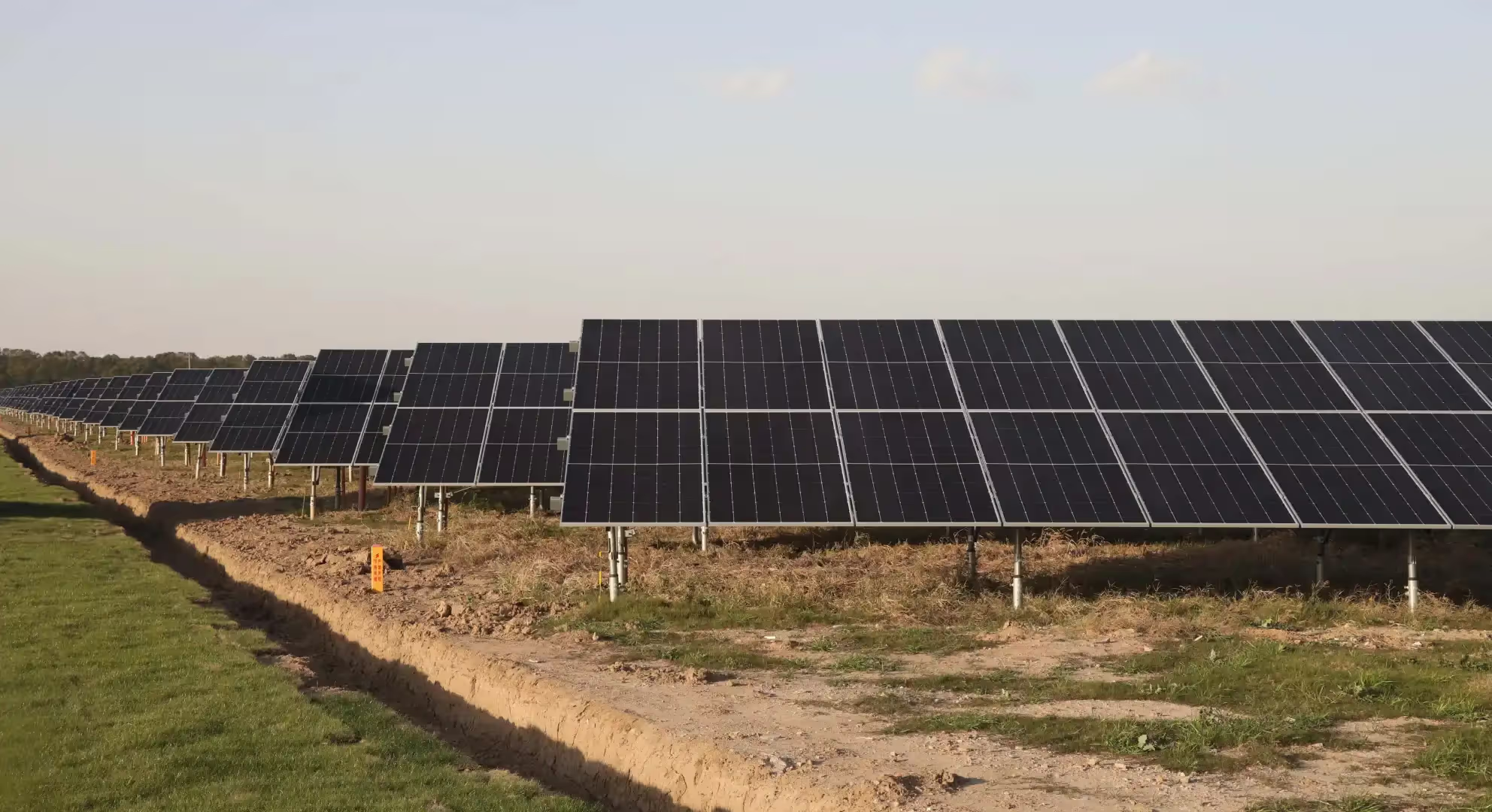
The Hi-MO X10 Guardian Anti-Glare Pro is currently being deployed in a large-scale photovoltaic replacement project in the Netherlands in an airport-adjacent environment, with more than 200,000 modules installed across multiple PV fields.
Anti-glare portfolio expansion for different application scales
The Anti-Glare Pro modules are part of the broader Hi-MO X10 Anti-Glare portfolio. The current range covers seven variants, including both standard Anti-Glare modules and Anti-Glare Pro versions.
The Pro versions are available in two formats, including a 66-cell configuration for C&I applications and a 54-cell format that can be used across both commercial and residential projects. This structure allows project developers and installers to select module sizes based on system design and site requirements while maintaining consistent optical performance.
Designed for projects with defined glare assessment requirements
With verified glare characteristics and high module efficiency, the Hi-MO X10 Guardian Anti-Glare Pro is intended for use in environments where reflection behavior must be predictable and documented. Typical applications include airport-adjacent developments, transport infrastructure, logistics sites, and urban installations with direct visibility constraints.
By defining reflection characteristics at module level, the solution provides a reliable basis for project planning and glare assessment, supports stakeholder alignment in approval processes, and reduces the need for corrective measures after installation, contributing to more predictable system performance in environments with defined visibility constraints.
More information: Anti-Glare Solar Panels: Less Reflection, More Certainty

Lorem ipsum dolor sit amet, consectetur adipiscing elit. Suspendisse varius enim in eros elementum tristique. Duis cursus, mi quis viverra ornare, eros dolor interdum nulla, ut commodo diam libero vitae erat. Aenean faucibus nibh et justo cursus id rutrum lorem imperdiet. Nunc ut sem vitae risus tristique posuere.