Engineering decisions define the long-term ROI in the industrial solar market of Ukraine
Date
April 29, 2026
read time
5
Minutes
Subscribe to the LONGi Newsletter

Ukraine's industrial solar market has entered a new phase, one where the quality of engineering decisions, not just the size of the installation, determines whether an investment pays off.
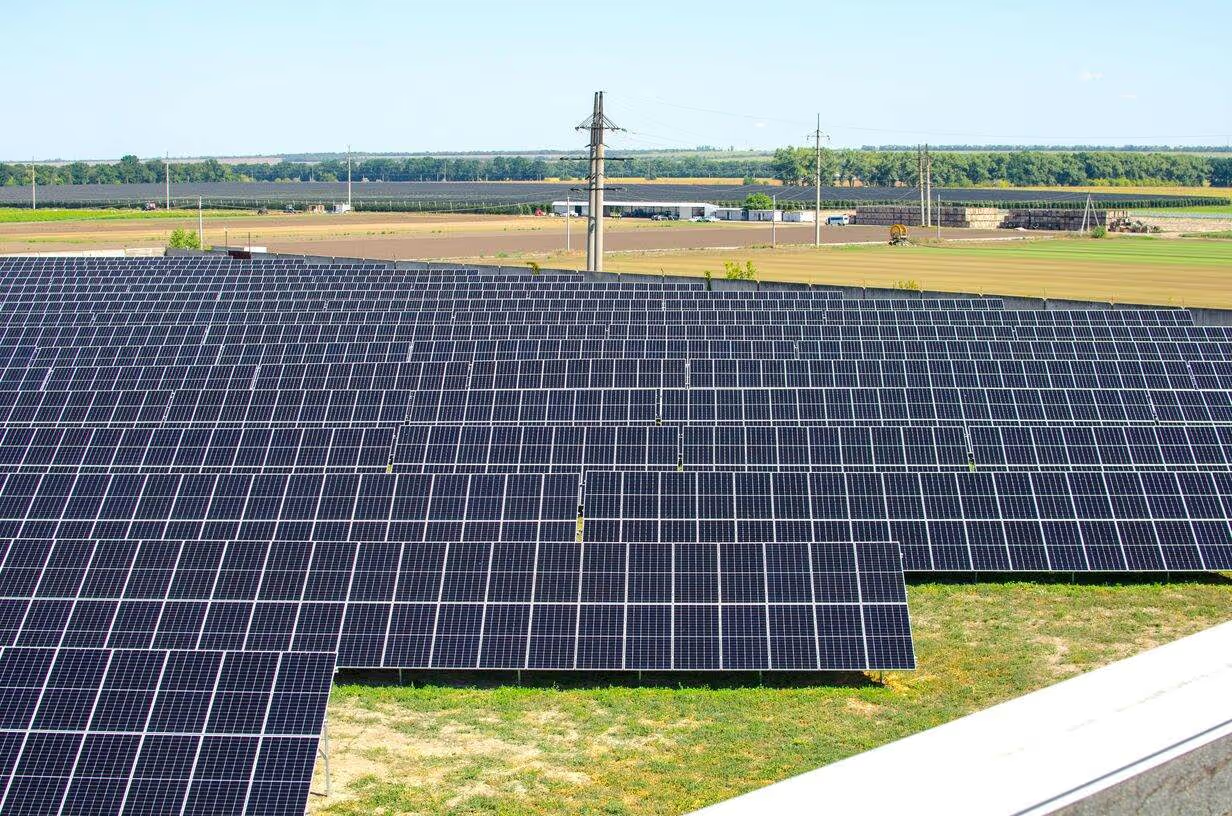
For investors evaluating industrial solar projects in Ukraine today, the financial stakes have never been more concrete. A 15.5 MW solar plant generates over 17 million kWh per year. Over a 25-year lifecycle, that is more than 425 million kWh, but the difference between a well-engineered project and a compromised one - measured in annual generation losses, panel degradation, and technology choices - can amount to over 114 million UAH (approximately EUR 2.2 million at current exchange rates) in revenue never earned. This is the new logic of solar investment in Ukraine and it is producing a more disciplined, more demanding class of investors.
Since 2022 energy security has transitioned from emergency response to a strategic infrastructure investment
Before 2022, businesses evaluating a solar project in Ukraine asked familiar questions: installed capacity, green tariff, payback period. These were reasonable questions for a stable, predictable market. The geopolitical conflict changed this approach entirely.
That vulnerability - repeated attacks on national energy infrastructure - has driven a significant wave of industrial solar investment across Ukraine. What began as emergency energy security has matured into something more strategic: a recognition that on-site solar generation is an infrastructure asset with a 25-year horizon, not a short-term cost-reduction measure.
Unified oversight from design to construction ensures projects deliver on their financial projections
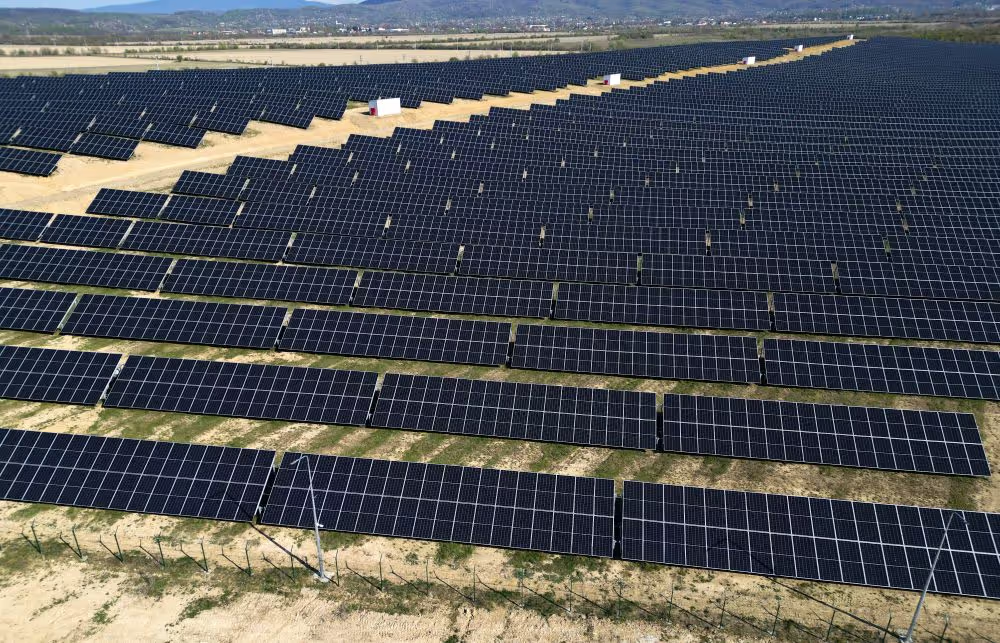
Ukraine's leading solar EPC contractor ETL Group has spent over a decade delivering projects at every scale, from industrial rooftop systems to utility-scale ground-mount installations. The EPC model, one team with full accountability across design, procurement, and construction, ensures the station is far more likely to generate exactly what the financial model projected from day one. "Investments are afraid of uncertainty," the ETL Group team notes. "What removes that uncertainty is complete technical oversight at every stage."
The financial loss of the wrong solar technology choice is significant
The most important number in any long-term solar investment is not the installed capacity. It is the annual generation loss and what it compounds into over 25 years.
ETL Group's calculation is direct: a 3% annual generation loss across a large industrial solar plant means over 12.7 million kWh never delivered to the grid over the project's lifetime. At current average day-ahead market tariffs in Ukraine, that translates to more than 114 million UAH (approximately EUR 2.2 million at current exchange rates) in lost revenue (without VAT). "Even 1% of annual generation losses is millions of hryvnias in lost income," says Denis Kosoy, CEO and co-founder of ETL Group. "The difference between quality implementation and a compromise, over a 25-year horizon, can reach hundreds of millions of hryvnias."
This is why the choice of solar module manufacturer has become a financial modelling decision, not a procurement line item. The most expensive problems, as ETL Group points out, don't appear at commissioning. They appear at year seven or year ten, when guarantees have expired and the contractor is no longer on site.
Advanced back contact technology protects long-term ROI by significantly reducing shading and resistive losses
LONGi's Hi-MO X10 modules and the HPBC 2.0 architecture provide the specific technical resilience needed to protect the Ukrainian investment case over two decades.
HPBC 2.0, which stands for Hybrid Passivated Back Contact 2.0 technology, moves all electrical contacts to the rear of the solar cell. This eliminates front-side busbar shading and maximises the active surface area available to capture solar irradiation, delivering higher power output per square metre than conventional cell architectures. The zero-busbar structure reduces resistive losses across the module, while bifacial performance captures reflected irradiation from the ground surface, adding generation where standard modules lose it.
For Ukrainian industrial solar investors, the shading performance of HPBC 2.0 is particularly significant. In partial shading conditions, the kind caused by clouds passing over a large ground-mount array, by terrain features, or by adjacent structures, HPBC 2.0 modules achieve more than 70% fewer energy losses compared to mainstream TOPCon products. In practical terms, this delivers the performance equivalent of a built-in power optimiser across the entire array, without additional hardware or complexity.
Slower degradation over time means the generation curve of an HPBC 2.0-equipped plant stays closer to its original financial model for longer. In a 25-year infrastructure asset, this is not a marginal improvement. It is the compounding advantage that determines whether the plant outperforms its model or quietly underdelivers it.
"Local EPC partners are the first to see in practice the improvement in project ROI thanks to the higher efficiency of next-generation modules," says Gencay Sandalcı, LONGi Solar's representative for Eastern Europe. "That experience makes them strong drivers of innovative technology adoption."
The manufacturer's financial stability must be part of the investment plan
Sophisticated investors in Ukrainian solar are now adding one more layer to their due diligence: the long-term financial health and commitment of the module manufacturer themselves.
In the solar industry, Tier 1 status published quarterly by BloombergNEF identifies manufacturers whose equipment international banks are prepared to accept as the basis for project financing. Achieving it requires passing rigorous due diligence from the global banking community on financial stability, product reliability, and long-term warranty capability.
LONGi has held Tier 1 status continuously, remaining in the first category as of Q1 2026. For investors, this carries a specific meaning in the context of a 25-year solar asset. It is an independent, third-party confirmation that the manufacturer will be present and capable of fulfilling its commitments for the entire life of the station, not just at commissioning.
For projects that depend on project financing, Tier 1 status also means simpler access to capital. Banks are more willing to lend against assets equipped with bankable technology from financially stable manufacturers.
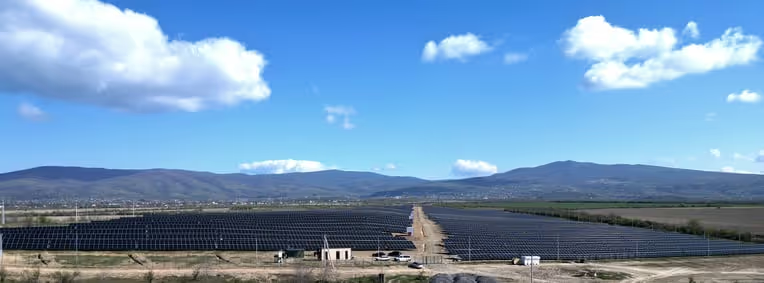
The success of national reconstruction depends on Ukrainian solar investments maintaining stable performance over decades
Ukraine's energy reconstruction will not happen through a single large decision. It will be built project by project, each one a choice of technology, contractor, and manufacturer. Each one either building value or quietly losing it over 25 years.
The investors who understand this are already asking better questions. Not just how much capacity, but how much of that capacity will still be performing in the long run. Not just what is the payback period, but what assumptions about degradation and generation losses sit behind that number and how defensible they are.
This is the benchmark ETL Group and LONGi have set across their joint projects in Ukraine: engineering precision that matches the financial model, technology that holds its performance curve across decades, and a standard of accountability that doesn't disappear after commissioning.
As Ukraine moves toward reconstruction and deeper integration with European energy markets, including the potential for electricity export to the EU, the quality of these foundational projects will matter more, not less. The plants being built today are the infrastructure that recovery runs on.
In a long-term asset, every engineering decision compounds. The right ones quietly outperform their models for decades. The wrong ones reveal themselves slowly and expensively.

Lorem ipsum dolor sit amet, consectetur adipiscing elit. Suspendisse varius enim in eros elementum tristique. Duis cursus, mi quis viverra ornare, eros dolor interdum nulla, ut commodo diam libero vitae erat. Aenean faucibus nibh et justo cursus id rutrum lorem imperdiet. Nunc ut sem vitae risus tristique posuere.