Li Zhenguo (LONGi) Prevades: Back Contact Solar Cells to Lead Market Share by 2028
Date
June 26, 2025
read time
3
Minutes
Subscribe to the LONGi Newsletter

LONGi's Strategic Vision: Dominating the Future of Solar with Back Contact Technology
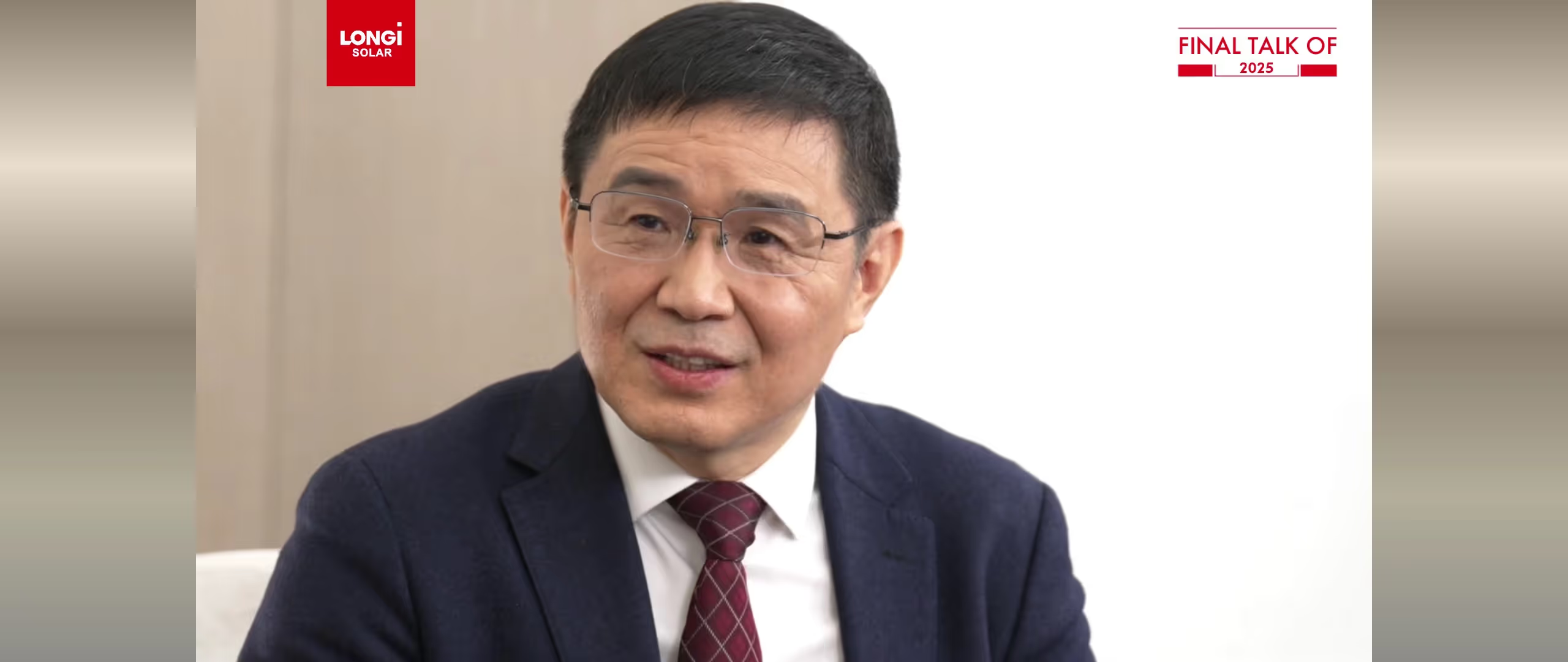
In a candid interview with the Chinese business magazine Caijing, LONGi Chairman and President, Li Zhenguo, shared profound insights into the company's strategic realignments, unwavering commitment to back contact (BC) solar cell technology, and the trajectory of the global photovoltaic industry. The discussion, moderated by Executive Editor Mark, addressed market apprehensions regarding LONGi's technological roadmap and its competitive positioning amidst industry-wide transitions.
Li revealed that LONGi implemented three pivotal shifts in 2024 to fortify its market standing. Firstly, the company achieved a significant technological breakthrough in developing the second generation of BC cells. According to Li, by the latter half of 2025, LONGi aims to achieve an internal production capacity of 50 GW for BC cells, supplemented by an additional 10 GW through partnerships. This initiative positions the product as a frontrunner in large-scale photovoltaic manufacturing.
Secondly, Li explained that LONGi has streamlined its internal structure, reducing redundancies and reinforcing team synergy. Thirdly, the company has redefined its strategic focus, expanding beyond module production to increasingly concentrate on tailored applications for specific scenarios, including solar-plus-storage systems and projects involving hydrogen, ammonia, and methanol.
The Technical Superiority and Economic Viability of BC Cells
When questioned about LONGi's steadfast confidence in BC technology despite market reservations, Li emphasized the clear foundational physics: conventional cells' front-side wires obstruct sunlight. By relocating all electrical contacts to the rear, BC cells eliminate shading losses and enhance efficiency. He noted that the industry had been hampered by the technology's complexity and cost. LONGi's persistent innovation over 7–8 years was instrumental in overcoming these barriers.
Li confirmed that these obstacles are now surmounted. The second-generation cells demonstrate efficiencies exceeding 98%, rivaling or surpassing TOPCon technology. He anticipates that financial indicators in the second half of 2025 will clearly illustrate the cost advantages of BC cells.
An unexpected benefit also emerged: the co-planar design of electrodes in BC modules enhances safety due to a simplified bypass configuration—an advantage the team initially underestimated.
Market Projections and LONGi's Innovation Philosophy
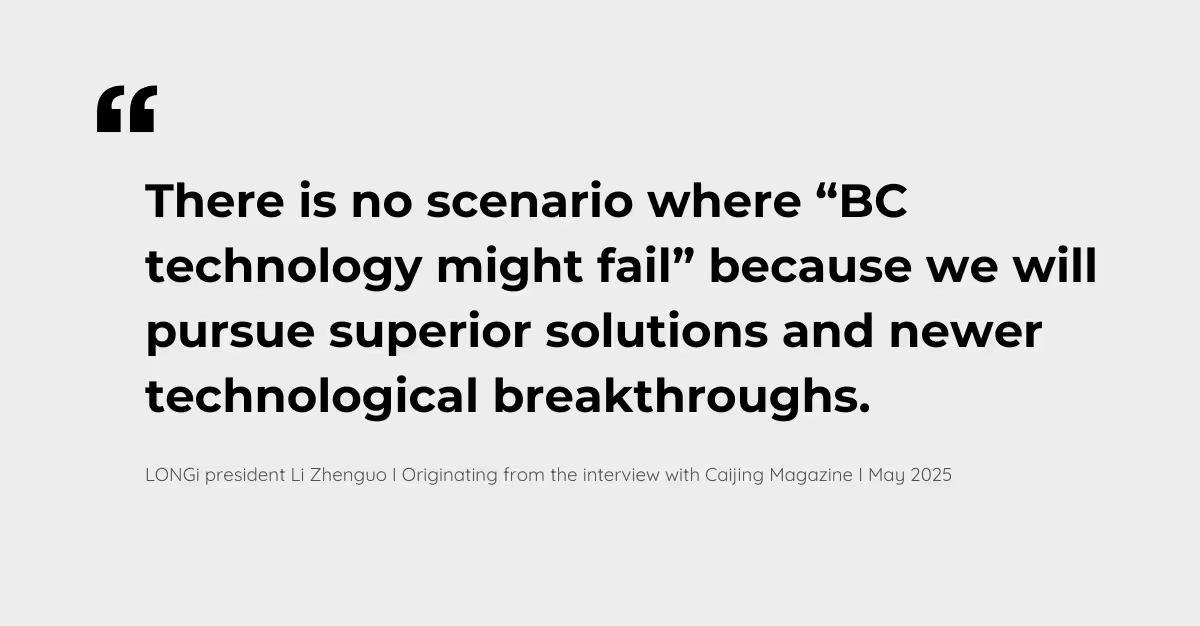
Looking ahead, Li projects that BC cells will capture over 30% of the global market share by 2028, potentially exceeding 50% by 2030. Dismissing the notion of a fallback plan should BC technology not meet its objectives, Li asserted that LONGi would perpetually pursue next-generation, superior-performing solutions. While the first generation of BC products faced limitations due to the rapid advancement of TOPCon, the second generation has already surpassed those performance metrics.
According to Li, each iteration of BC technology builds upon its predecessor, establishing a robust foundation for future advancements. He characterized LONGi's R&D philosophy as "broad research, focused implementation," explaining that the company continuously explores multiple technological avenues concurrently. Within this framework, BC is not an endpoint but an integral component of a broader innovation ecosystem, encompassing alternative solutions under development.
The Next Frontier: Beyond Silicon
Regarding the next evolutionary step in solar technology, Li stated that monocrystalline silicon cells are approaching their theoretical efficiency limit of 29.4%. With labs nearing 28% and mass production hovering around 27%, he identifies tandem cells as the crucial next advancement for cost-efficiency. However, he cautioned that perovskite-based tandem technology remains immature, with its large-scale feasibility yet to be confirmed.
Li concluded by reflecting on China's global leadership in the photovoltaic industry. He attributed this success to the dedication of Chinese PV professionals and the open nature of solar innovation over the past decade. New technologies rapidly became shared industry knowledge, facilitated by a highly integrated supply chain for equipment and materials.
Caijing magazine is a prominent Chinese publication focusing on finance, economics, business, and public policy. Founded in June 1998 by journalist Hu Shuli, the Beijing-based magazine is published bi-monthly and is recognized for its in-depth analysis and critical perspectives on China's economic reforms and capital markets.

Lorem ipsum dolor sit amet, consectetur adipiscing elit. Suspendisse varius enim in eros elementum tristique. Duis cursus, mi quis viverra ornare, eros dolor interdum nulla, ut commodo diam libero vitae erat. Aenean faucibus nibh et justo cursus id rutrum lorem imperdiet. Nunc ut sem vitae risus tristique posuere.