LONGi's Li Zhenguo: BC Cells to Dominate 30%+ of Global Market by 2028
Data
June 26, 2025
tempo di lettura
3
Minuti
Iscriviti alla Newsletter LONGi

LONGi's Strategic Vision: The Rise of Back Contact (BC) Solar Cells
In an insightful interview with the esteemed Chinese economic publication, Caijing Magazine, LONGi's founder and president, Li Zhenguo, unveiled the company's strategic adjustments, unwavering commitment to Back Contact (BC) solar cell technology, and a clear vision for the future of the global photovoltaic (PV) industry. Addressing market concerns about LONGi's technological roadmap and competitive standing during a sector-wide transition, Li's insights provide a crucial look into the brand's forward-thinking approach.

LONGi's 2024 Strategic Overhaul
Li outlined three pivotal shifts implemented by LONGi in 2024 to solidify its market leadership:
- Technological Breakthrough in Second-Generation BC Cells: LONGi has achieved a significant milestone in second-generation BC cell technology. By the latter half of 2025, the company aims for a proprietary BC cell production capacity of 50 GW, supplemented by an additional 10 GW through partnerships. This positions BC as the world's most advanced mass-produced photovoltaic product.
- Streamlined Operations and Enhanced Teams: The company has optimized its internal structure, focusing on efficiency and strengthening its core teams.
- Expanded Strategic Focus: LONGi is broadening its scope beyond module manufacturing to emphasize scenario-based applications, including solar and storage systems, and pioneering projects in hydrogen, ammonia, and methanol development.
The Unwavering Confidence in BC Technology
Addressing market skepticism surrounding BC technology, Li elucidated the fundamental physics: conventional solar cells suffer efficiency losses due to front-grid lines blocking sunlight. BC cells eliminate this shading by relocating all electrodes to the rear, thereby boosting energy conversion. Overcoming the historical challenges of complexity and cost, LONGi has dedicated seven to eight years to technological innovation, successfully resolving these barriers.
Second-generation BC cells reportedly achieve efficiencies exceeding 98%, rivaling or surpassing TOPCon technology. Li anticipates that the cost advantages of BC will become evident in the second half of 2025 financial indicators. Furthermore, a surprising benefit has emerged: the planar electrode design in BC modules enhances safety through a simplified bypass configuration, a factor initially underestimated by the team.
Forecasting BC Market Dominance
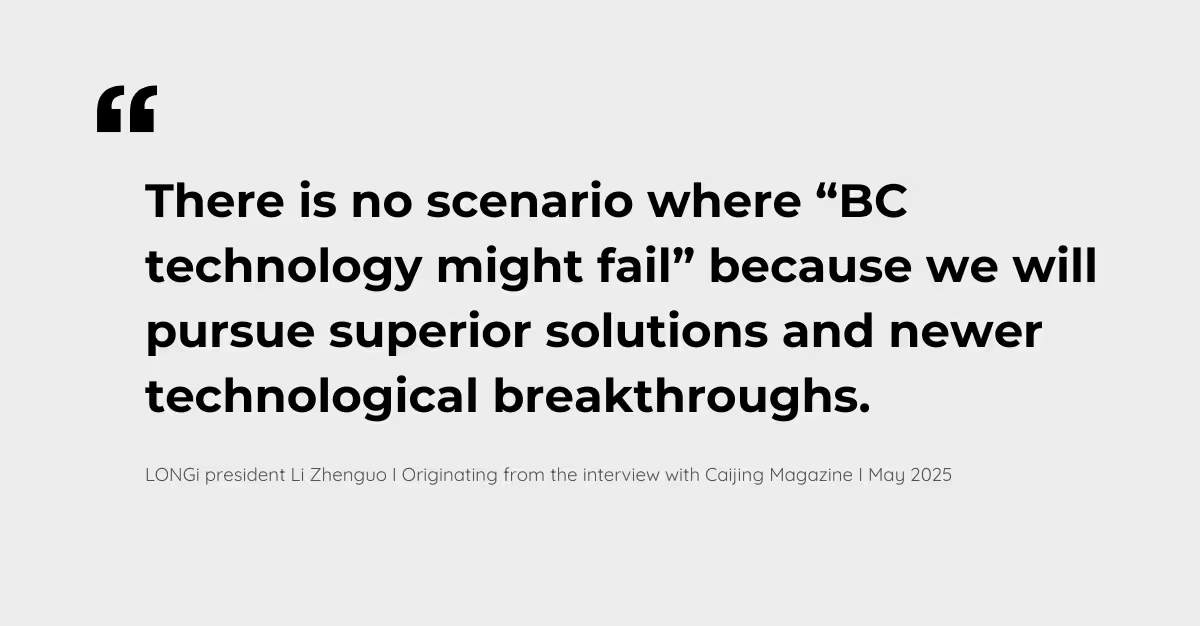
Li projects that BC cells will capture over 30% of the global market share by 2028, with the potential to exceed 50% by 2030. He dismissed the notion of an emergency plan for BC underperformance, emphasizing LONGi's continuous pursuit of superior, next-generation solutions. While first-generation BC products met technical expectations, they initially appeared less competitive against the rapid advancements of TOPCon. However, the second generation has decisively surpassed TOPCon in performance, building a robust foundation for future development.
LONGi's R&D philosophy, described as "broad research, focused implementation," involves exploring multiple technological directions concurrently. BC technology is not an isolated endeavor but an integral part of a broader innovation ecosystem, with alternative solutions already under development.
The Next Frontier: Tandem Cells
Looking ahead, Li identified tandem cells as the next significant leap in cost-efficiency, as monocrystalline silicon cells approach their theoretical efficiency limit of 29.4%. While lab efficiencies are nearing 28% and mass production hovers around 27%, perovskite-based tandem cells, despite their potential, remain immature with considerable uncertainty regarding large-scale engineering feasibility.
China's PV Leadership: A Collaborative Success
Reflecting on the Chinese photovoltaic industry's global leadership, Li attributed this success to the dedication of Chinese PV professionals and the open-source nature of solar innovation over the past decade. Rapid dissemination of new technologies as shared industry knowledge, coupled with a highly integrated supply chain of equipment and material providers, has been instrumental.
Caijing Magazine, founded in June 1998 by Hu Shuli, is a leading Chinese publication based in Beijing, known for its in-depth reporting on finance, economics, business, and public affairs.

Lorem ipsum dolor sit amet, consectetur adipiscing elit. Suspendisse varius enim in eros elementum tristique. Duis cursus, mi quis viverra ornare, eros dolor interdum nulla, ut commodo diam libero vitae erat. Aenean faucibus nibh et justo cursus id rutrum lorem imperdiet. Nunc ut sem vitae risus tristique posuere.