LONGi HPBC 2.0 Modules: First to Achieve TÜV SÜD PID-p Resistance Certification
LONGi's Hi-MO 9 and Hi-MO X10 modules are industry pioneers, securing TÜV SÜD certification for Potential Induced Degradation - Polarization (PID-p) resistance, a critical factor for advanced solar reliability.
Date
June 12, 2025
timp de citire
1
Minute
Informații de contact
Echipa noastră prietenoasă ar dori să ia legătura cu dvs.
Subscribe to the LONGi Newsletter

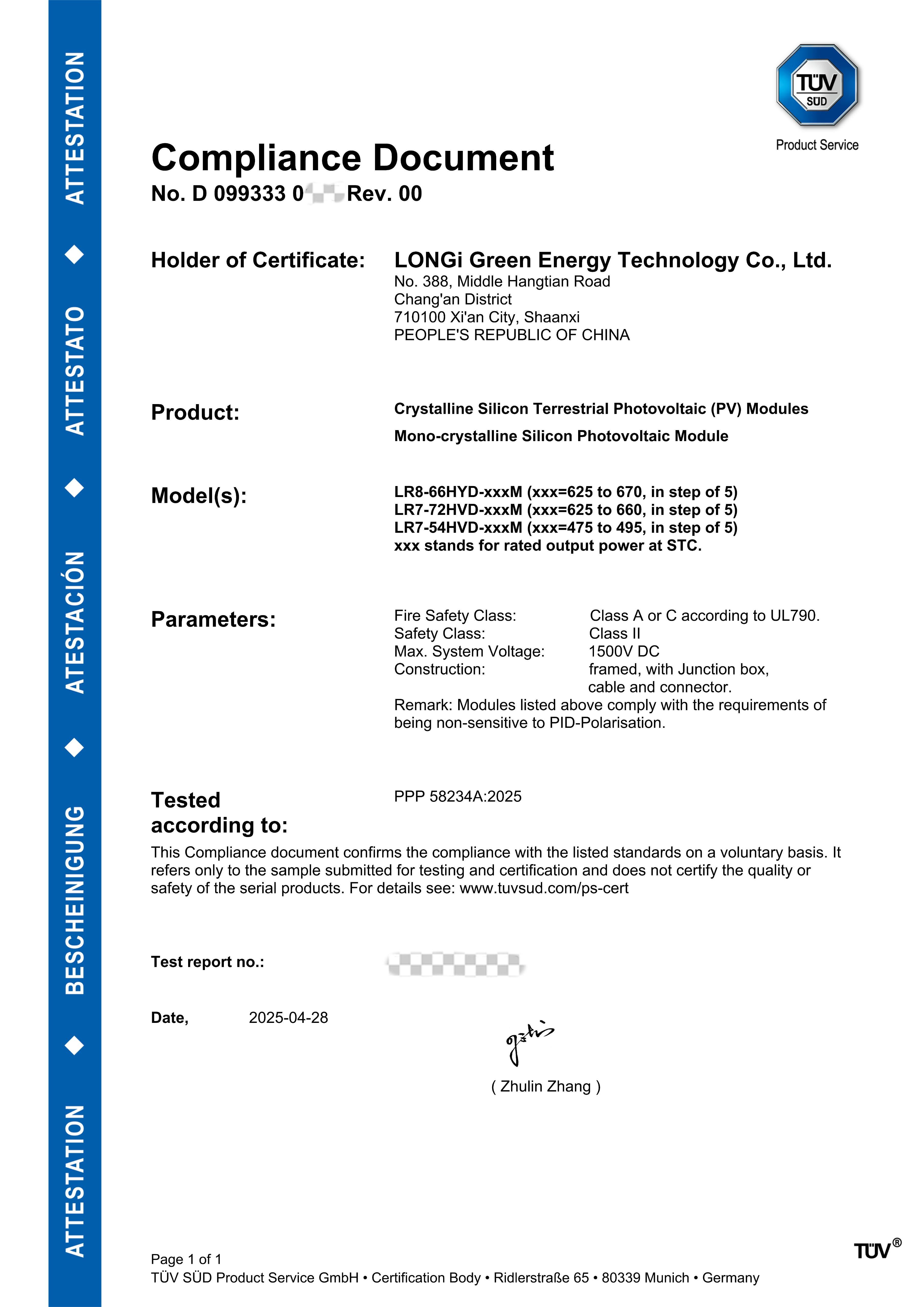
LONGi's Back Contact HPBC 2.0 modules – Hi-MO 9 for utility-scale scenarios and Hi-MO X10 for residential and commercial applications – are the industry's first to obtain TÜV SÜD certification for resistance to potential induced degradation - polarization (PID-p), in accordance with standards PPP 58234A:2025 and IEC TS 62804-1 Ed2 (DTS).
Addressing a Critical Reliability Risk
PID-p (Potential Induced Degradation – Polarization) represents a growing concern for the reliability of advanced photovoltaic modules. This phenomenon occurs when the electric field generated by system voltage induces polarization effects within the passivation layer of silicon cells, leading to reversible power losses.
Unlike PID-s (shunting), which causes more permanent damage, PID-p develops more rapidly but allows for performance recovery through light exposure, particularly ultraviolet radiation. The increasing relevance of this phenomenon has captured the attention of international standardization bodies like IEC and renowned research institutions such as NREL.
Durability Testing Under Polarization Stress – Excellent Results
The TÜV SÜD testing process simulates real-world stress conditions by combining electrical voltage, temperature, and light exposure to assess the modules' durability against PID-p degradation.
Both Hi-MO 9 and Hi-MO X10 have successfully passed these tests with excellent results, confirming their robust resistance to PID-p in demanding operational environments.
Confirming Technological Leadership and Back Contact Architecture Maturity
By achieving TÜV SÜD certification for PID-p resistance, LONGi reinforces its leadership position in addressing long-term degradation mechanisms in high-efficiency photovoltaic modules.
This accomplishment reflects the maturity of the HPBC 2.0 architecture and the company's commitment to combining long-term reliability with high energy performance.
Commitment to Standards and Industry Advancement
LONGi continues to collaborate closely with independent certification bodies like TÜV SÜD to contribute to raising global standards in the photovoltaic industry.
Through continuous research, development, and testing activities, the company supports the sustainable advancement of solar technology and contributes to the global energy transition.

Lorem ipsum dolor sit amet, consectetur adipiscing elit. Suspendisse varius enim in eros elementum tristique. Duis cursus, mi quis viverra ornare, eros dolor interdum nulla, ut commodo diam libero vitae erat. Aenean faucibus nibh et justo cursus id rutrum lorem imperdiet. Nunc ut sem vitae risus tristique posuere.