LONGi's Vision: Chao Jia on Pushing Solar Boundaries and the Backcontact Leap
Datum
June 26, 2025
Leestijd
2
Minuten
Abonneren op de LONGi Nieuwsbrief

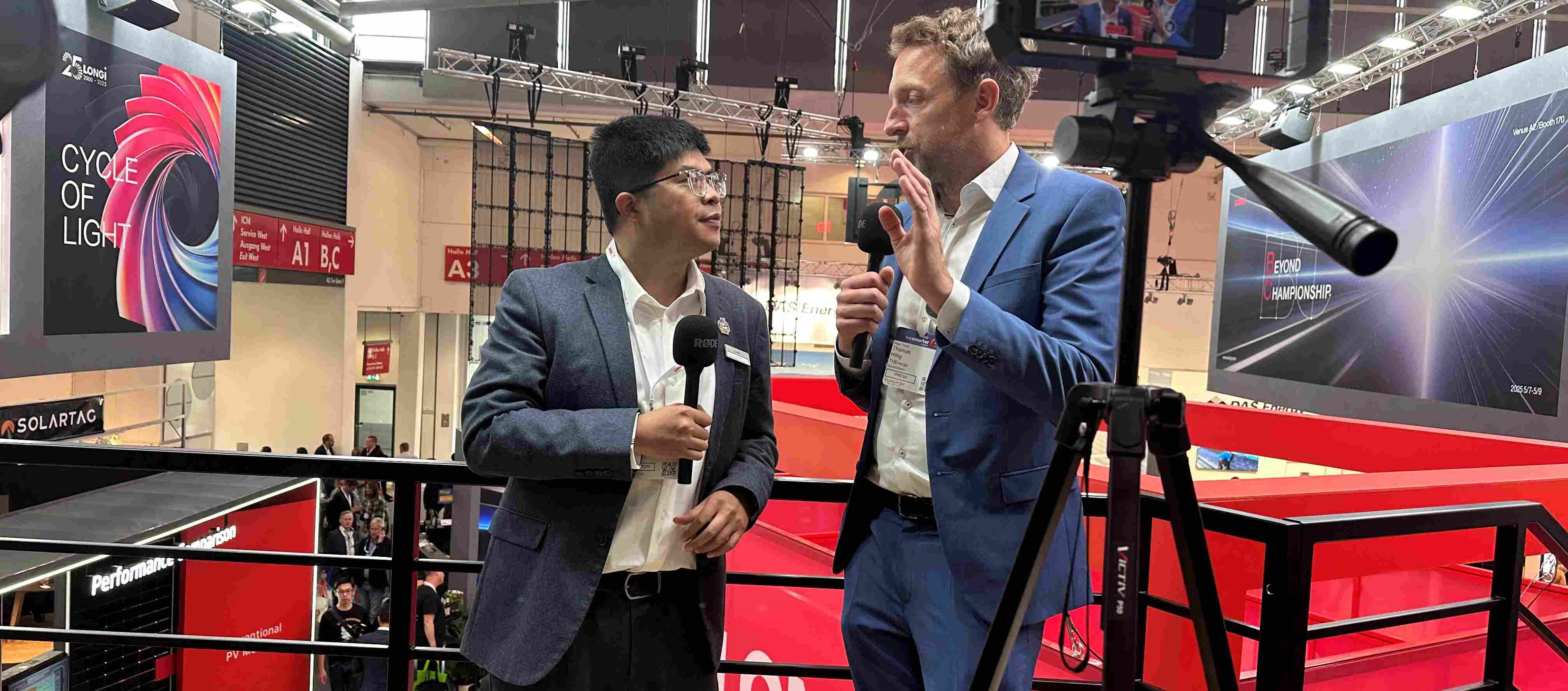
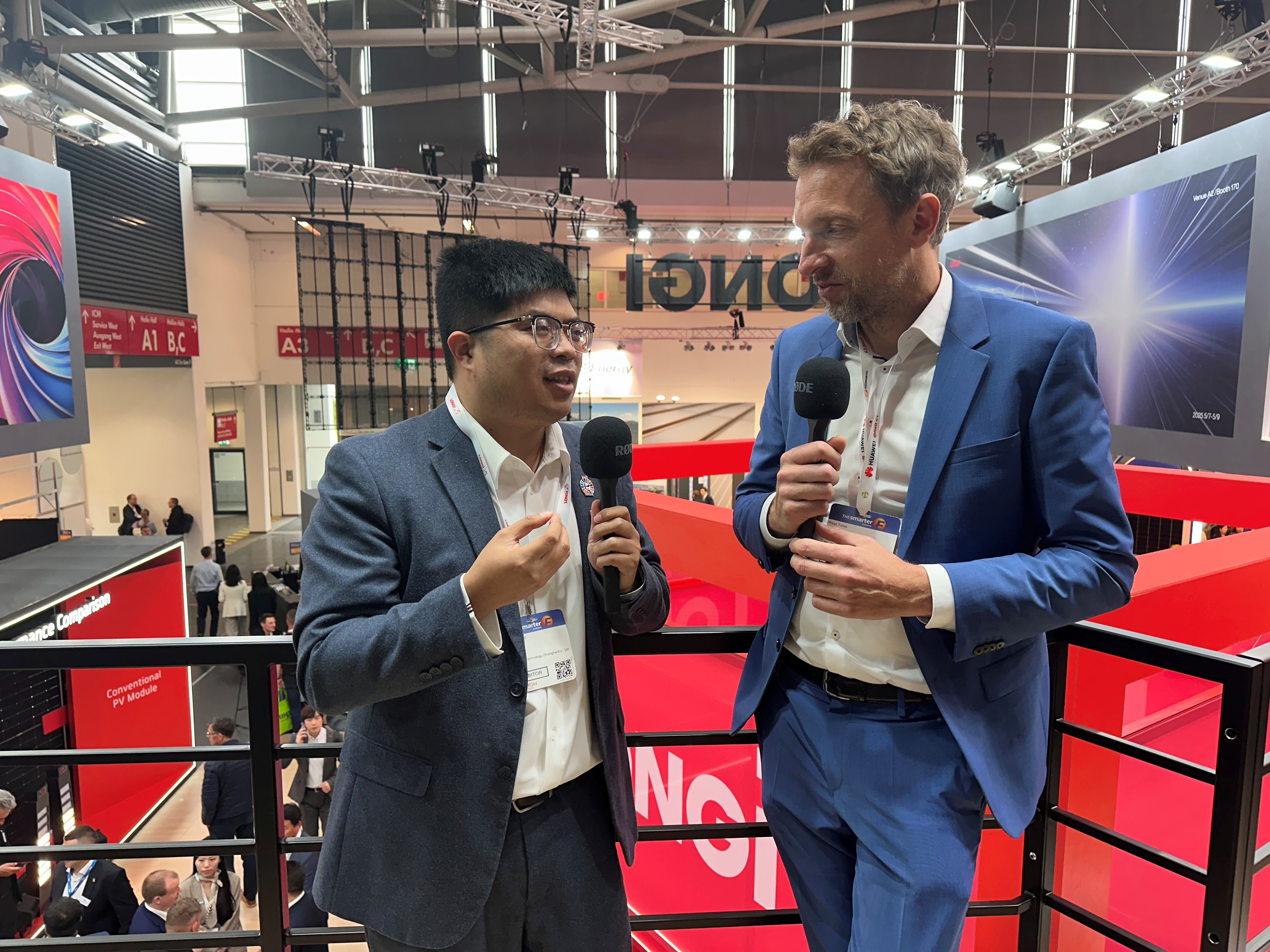
At Intersolar Europe 2025 in München, solar strategist and moderator Thomas Hillig spoke with Chao Jia, President of LONGi Europe for DG, to explore the company's role in shaping the past, present, and future of solar energy. The conversation revealed more than just a roadmap of product launches; it unveiled LONGi's philosophy, its scientific roots, and a bold commitment to pushing boundaries. Here are the four key insights from the exchange.
LONGi's Culture: Science-Driven, Not Hype-Fueled
When asked about LONGi's position in the ongoing solar energy efficiency race, Chao Jia began not with product milestones, but with a story: the company's name honors the founders' physics professor. "Our bosses are scientists," he explained. "They believe in numbers." This mindset, Jia argued, is why LONGi doesn't just follow market trends; it helps shape them.
In 2005, monocrystalline silicon represented only 1% of the PV market. LONGi not only championed monocrystalline technology but also shared crucial intellectual property to accelerate its adoption across the industry. That shift marked the beginning of what Jia termed the 'efficiency revolution' in photovoltaics. The ethos remains unchanged. From the invention of PERC to bifacial modules, LONGi's history mirrors a roadmap of the sector's key technical milestones.
Solar Energy Nears Physical Limits of Current Technologies
"Today, we are close to the limit of single PN junctions," Jia noted. LONGi has already achieved over 28% efficiency with current-generation cells, just shy of the theoretical ceiling of 29.1%. This is why LONGi is embracing back-contact (BC) technology, which Jia called the "final boost" for conventional cell architectures.
However, this is not the end of the line. Tandem cells in the lab have already surpassed the 35% efficiency mark, and Jia sees potential for exceeding 40% in the future. At that level, entirely new applications emerge: "If a mobile phone has 40% solar efficiency, it could self-charge," he posited. While such applications are on the horizon, the foundational lab work is already underway.
Back-Contact is a Data-Driven Decision, Not a Gamble
Hillig pointed out that BC technology features prominently in LONGi's product lineup. Jia was quick to clarify: this is not a gamble. "As long as I don't gamble," he stated. "We invested in all directions – PERC, TopCon, HJT, tandem. But we follow the numbers."
The ceiling is clear: around 29%. "Only back-contact can get us there," Jia asserted. As the company's leadership is grounded in science, decisions are based on technical ceilings and long-term potential, not short-term market demand.
The Next Generation is Here: EcoLife and Hi-MO 9
At Intersolar, LONGi unveiled two key products showcasing its commitment to BC. The EcoLife series, targeting the residential sector, delivers up to 500 W from a 54-cell module with an efficiency of up to 25%, setting a new benchmark for its class. Meanwhile, the Hi-MO 9 pushes the boundaries for utility-scale projects, offering 670 W with over 80% bifaciality, addressing previous concerns about the bifacial performance of BC modules.
These are not concepts; they are commercial products built on the company's R&D foundation. "This is what we are bringing to Intersolar," Jia stated. "The record efficiency is not just in the lab. It's in our booth."
Watch the full interview here: https://www.linkedin.com/posts/longi-solar-europe_intersolar-solarinnovation-longi-activity-7329084410757005312-V1pH/

Lorem ipsum dolor sit amet, consectetur adipiscing elit. Suspendisse varius enim in eros elementum tristique. Duis cursus, mi quis viverra ornare, eros dolor interdum nulla, ut commodo diam libero vitae erat. Aenean faucibus nibh et justo cursus id rutrum lorem imperdiet. Nunc ut sem vitae risus tristique posuere.
.avif)